Product comparison

By , founder of NEDIO

Published · Updated

Free Brain.fm alternatives (and cheaper ones)

A free Brain.fm alternative exists for the part most people use: steady audio that helps them settle into work. Brain.fm itself costs $14.99 a month or $99.99 a year, and once the trial ends there is no free plan. What nothing free reproduces is Brain.fm’s modulated music itself. Below is what each alternative keeps and what it drops.

brain.fm
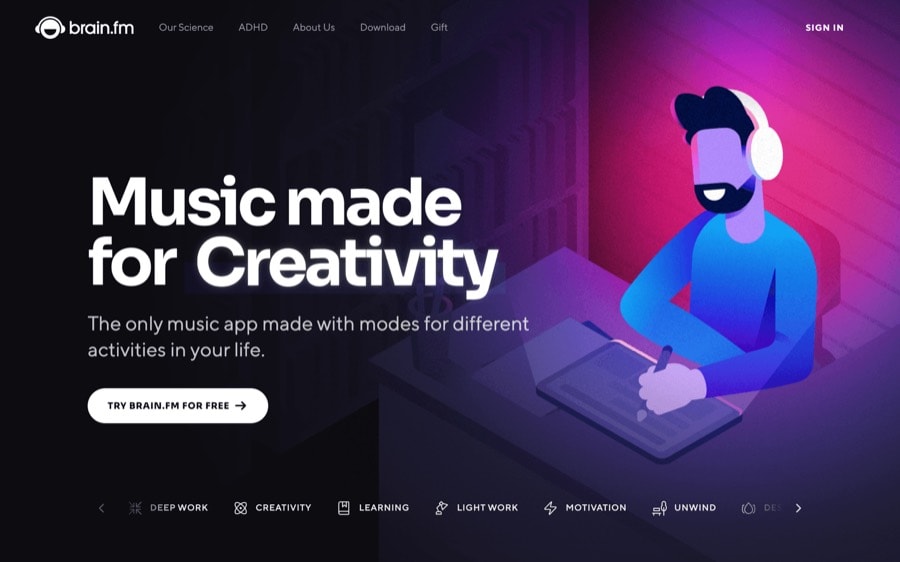
Brain.fm homepage

The short answer: which Brain.fm alternative is free

Four of the six are free to keep using: myNoise (browser, no account, no daily cap), Noisli (1.5 hours a day), Portal (iPhone and iPad) and NEDIO (30 minutes of audio a day without an account, 60 with a free one). focus.music and Endel are paid, and only focus.music is cheaper than Brain.fm.

NEDIO is our product, and it is listed second because it is free to use with a daily limit. Every price on this page was read from the vendor’s own page or app-store listing on October 23, 2026.

What a year of each one costs

Monthly prices hide the real comparison. Here is the yearly price of each paid plan, next to what you get without paying at all.

AppWithout payingPaid, per yearOther options
Brain.fmTrial only$99.99or $14.99 a month
myNoiseCurated set, no cap$0optional $10–$30 once for every generator
PortalOpen Access on iPhone/iPad$29.99or $2.99 a month, $99.99 lifetime
focus.music7-day trial$39.99or $4.99 a month
NEDIO30–60 min audio a day$119.90or $11.99 a month
Noisli1.5 hours a day$120Pro at $10 a month, billed yearly
EndelLimited Free Edition$119.99or $19.99 a month, $124.99 lifetime (US App Store)

US dollar prices before tax. Endel’s are from the US App Store and vary by region and by promotion; Portal’s were checked on its pricing page on October 9, 2026.

What Brain.fm gives you, so you know what you are replacing

Brain.fm is a music app sold by activity. Focus has five modes (Deep Work, Creativity, Learning, Light Work and Motivation), Relax has four, Sleep has five, including a power nap, and there is a Meditate section with guided and unguided sessions. A short quiz sets how strong the “neural effect” is, and you can turn it up later. There is a count-up timer for open-ended work and a countdown for breaks. It runs on the web, iOS, Android and desktop, and the company markets it as “the first music app designed for ADHD.”

Most people who leave use one or two of those things. If you press Deep Work and let it run, you are paying for a focus soundtrack, and that is the easiest part to replace: every option below does it, three of them for free. If you use the focus, sleep and meditation sections together, only Endel covers the same ground, and it does not cost less.

The one thing none of them copies is Brain.fm’s method: composed music with fast amplitude modulation added on purpose. Whether that matters to you is the question in the research section below.

Brain.fm pricing, free trial and student discount

Brain.fm’s pricing page lists two plans: $14.99 a month, or $99.99 a year, which comes to about $8.33 a month. Both unlock the whole app. There is no free tier and no lifetime plan.

The free trial depends on the plan you start. Brain.fm’s own guide to whether it is worth it says it is typically 7 days on the monthly plan and 14 on the yearly one, that some partner links extend it to 30, and that billing starts automatically when the trial ends. The yearly plan has a money-back guarantee.

Students get 20% off by emailing Brain.fm’s support from a .edu address or sending proof of enrollment, which brings the yearly plan to about $80.

So is Brain.fm free? Only for the trial. It is sold through its own web player and apps; we found no official free stream on YouTube or Spotify, so uploads promising “free Brain.fm” are not from the company. If you want to keep listening without paying, the free options below are the legitimate route.

Does Brain.fm work, and is it legit?

It is legit: a real company with public prices, apps on every major platform and published research. Its marketing goes further than that research, which is worth knowing before you pay for the difference.

Brain.fm’s homepage says its focus music “has been proven to boost focus-associated beta brainwaves by 119%” and that it is more effective than binaural beats, Spotify and YouTube focus playlists. The page does not say how either figure was measured.

The most relevant peer-reviewed test we found is a 2024 study of music with fast amplitude modulation on a sustained-attention task. Performance improved, but the effect showed up in the first block of the experiment rather than across the whole session. A published correction adds that the first author is a Brain.fm employee and that Brain.fm produced the music. That does not make the result wrong. It does make it one early, company-linked result on one lab task, not proof that the app will make your workday more productive.

The most useful honesty comes from Brain.fm itself. Its own guide says the app is not for you if free playlists already work, if you mostly do light tasks like email, if any background sound distracts you, or if you will not use it consistently. That is a good filter for anyone deciding whether to switch.

In practice: if Brain.fm felt noticeably better than ordinary instrumental music for you, keep it or try focus.music, the cheapest paid music app here. If you could not tell the difference, a free option will do the same job.

Six Brain.fm alternatives, free first

For each one: what you get, what you give up compared with Brain.fm, and who it is for.

Best free option

1. myNoise

People who want steady background sound for free, with no account and no daily cap.

myNoise is a library of noise and soundscape generators: rain, brown noise, cafés, rooms, machines. Each one has sliders, so you can push down the frequencies that annoy you and raise the ones that mask your actual room. A curated set on the homepage is free, has no ads and has no daily limit. Its creator says the aim is to keep it free and ad-free.

What you give up is music. myNoise is sound design, not composed tracks, and it has no work timer or activity modes.

Free
A curated selection of generators in the browser
Paid
$10–$30 once or $5 a month unlocks every generator on the website for life; mobile apps are sold separately
Pick it if
What you liked about Brain.fm was a steady wall of sound and you would rather pay nothing
mynoise.net
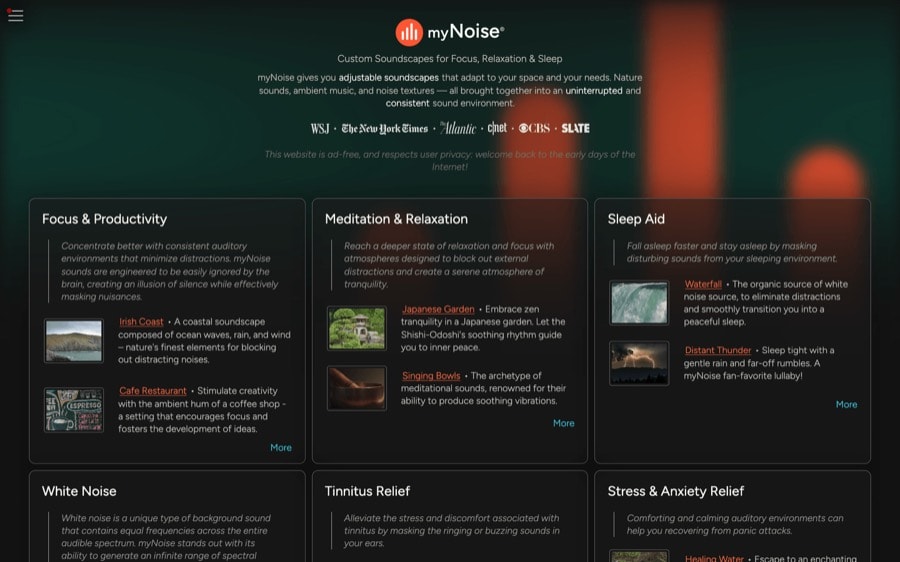
myNoise homepage listing free noise and soundscape generators

Free, with a work timer

2. NEDIO

People who used Brain.fm to get into a work block and want the timer and the task in the same tab.

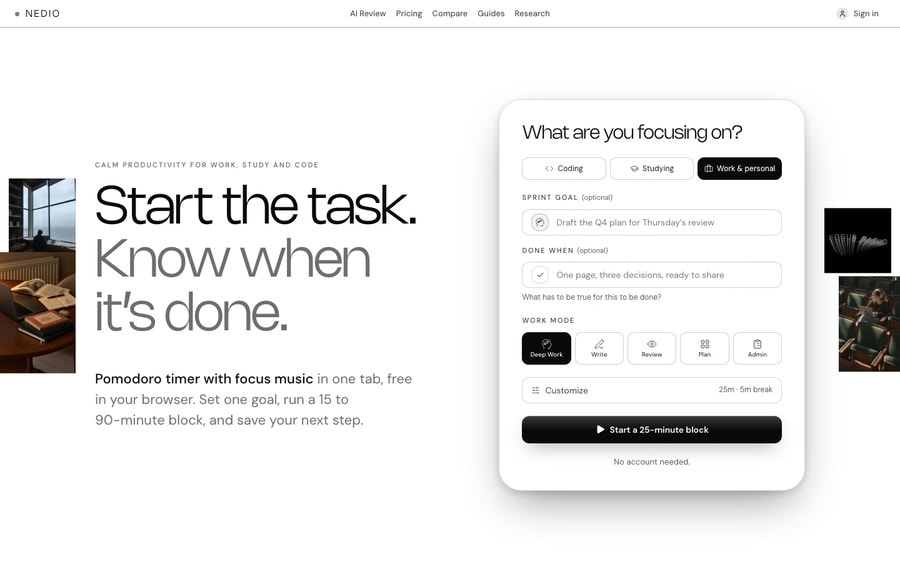
NEDIO is a focus timer with the audio built in. Before you start, you write one goal and what “done” means, then pick a sprint from 15 to 90 minutes, and instrumental audio starts with the timer. At the end you mark the goal done, partly done or not done and leave yourself the next step, so the following session starts where this one stopped.

The free plan includes 30 minutes of audio a day without an account, 60 with a free one. When it runs out, the audio and the running sprint stop until the next day. Pro removes the limit and adds a weekly AI Review of your sessions.

What you give up is choice. There is one instrumental stream per sprint, no stations, no sleep or relax modes and no claim about brainwaves. The music is generated in advance with a third-party tool and mixed by NEDIO. It is not performed by musicians and it does not adapt to you.

Free
30 minutes of audio a day without an account, 60 with a free one; timer, close-out and history included
Paid
Pro at $11.99 a month or $119.90 a year, with a 15-day trial
Pick it if
Brain.fm was your way into a work block, and the hard part is starting and finishing, not the soundtrack
nedio.xyz
NEDIO homepage with the sprint setup: a goal, a done-when line and a sprint length

Closest for less

3. focus.music

People who want focus music with channels and a timer, like Brain.fm, at well under half the price.

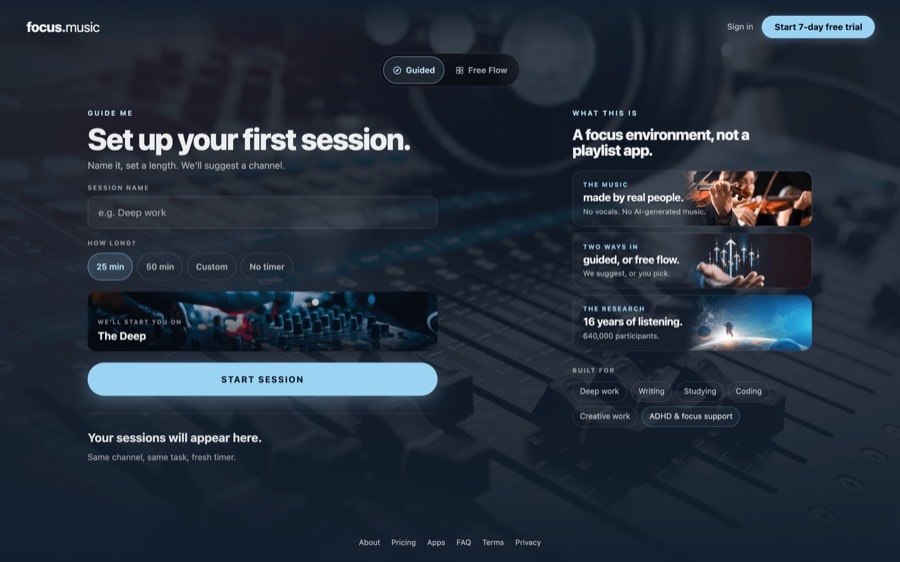
If you liked Brain.fm and the price was the only problem, start here. focus.music sells focus music organised into channels and energy levels, with sessions you can run to a timer or leave open-ended. It says the music is real and human-made. One subscription covers the web, iOS and Android.

It costs $4.99 a month or $39.99 a year, both after a 7-day free trial, so a year is $60 cheaper than Brain.fm. What you give up is a free plan, and it does not claim Brain.fm’s modulation method.

Free
7-day trial, then paid
Paid
$4.99 a month or $39.99 a year ($3.33 a month); both plans unlock everything
Pick it if
You want Brain.fm’s kind of focus music and timer for well under half the price
focus.music
focus.music homepage

Most similar all-day app

4. Endel

People who use Brain.fm for focus and sleep and want a similar all-day product rather than a saving.

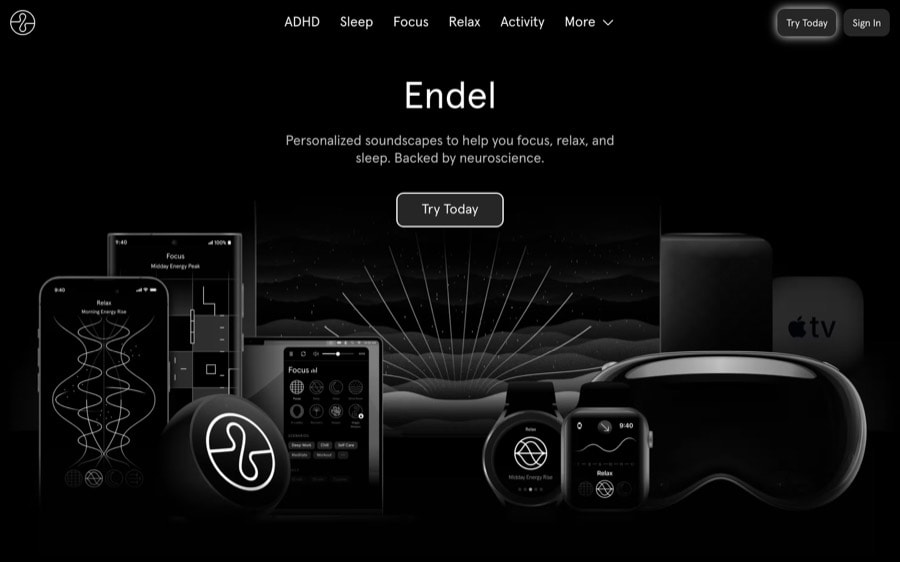
Endel is the most Brain.fm-like product here, and the least likely to save you money. It generates soundscapes that it says react in real time to the time of day, weather, heart rate and location, with modes for Focus, Relax, Sleep and Activity. It runs almost everywhere: iPhone, Android, Mac, Windows, the web, Apple Watch, Apple TV, Fire TV and Alexa.

If you skip the paywall, a limited Free Edition starts. Premium soundscapes, coloured noise and the focus timer need a subscription. The US App Store lists $19.99 a month, $119.99 a year or a $124.99 lifetime purchase, often alongside cheaper promotional offers.

Free
Limited Free Edition
Paid
$19.99 a month, $119.99 a year or $124.99 lifetime in the US App Store; varies by region
Pick it if
You use Brain.fm for focus and sleep and want the closest all-day replacement
endel.io
Endel homepage describing soundscapes that adapt in real time

Free mixer in a tab

5. Noisli

People who like mixing rain, café and brown noise for a couple of hours a day.

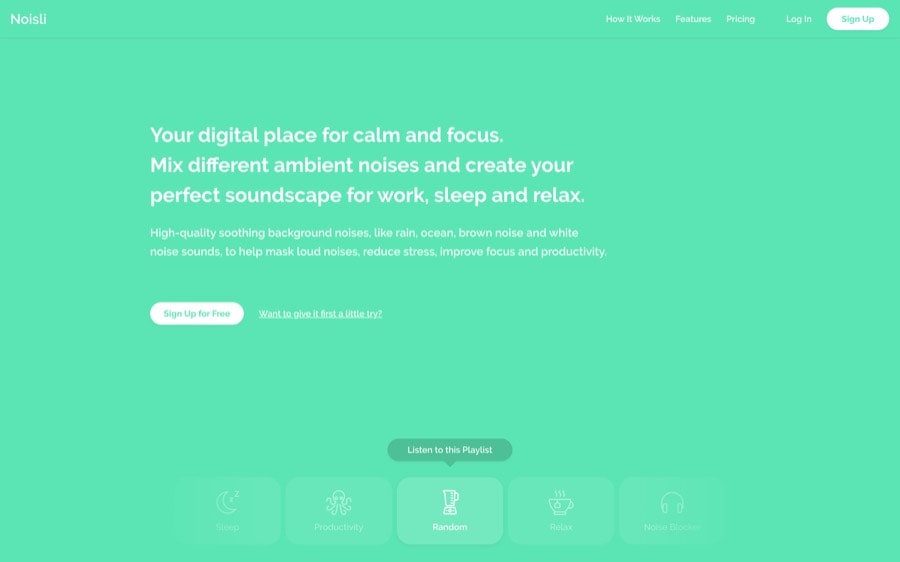
Noisli is a sound mixer for a browser tab: layer rain, wind, a coffee shop and brown noise until it sounds right, then save the mix. The free plan gives you 16 sounds, 1.5 hours of streaming a day, three curated playlists, five favourites, a simple timer and a plain text editor.

What you give up is music, and the daily cap: 1.5 hours ends a long workday early. Pro is $10 a month billed yearly for 28 sounds and unlimited streaming. Noisli is built for desktop browsers, with iOS and Android apps and a Chrome extension alongside.

Free
16 sounds, 1.5 hours a day, simple timer
Paid
Pro at $10 a month billed yearly; Business at $24 a month for two users
Pick it if
You want a mix of ambient sounds for a couple of focused hours a day
noisli.com
Noisli pricing page comparing the Free and Pro plans

Free on iPhone

6. Portal

iPhone and iPad users who want free, unlimited nature soundscapes.

Portal turns your phone into a window onto a place: a rainforest, a beach, a thunderstorm, with sound and visuals. Its Open Access tier on iPhone and iPad is free, with no ads and no usage or time limits, and includes focus and sleep timers. Premium unlocks more than 80 portals and the Mac app.

What you give up is Android and the web, and it is nature sound rather than focus music.

Free
Open Access on iPhone and iPad, no ads or time limits
Paid
$2.99 a month, $29.99 a year or $99.99 lifetime; 7-day Premium trial
Pick it if
You are on iPhone and want free, unlimited ambient sound

And the free option you already have

An instrumental playlist on Spotify or YouTube costs nothing, and Brain.fm’s own guide admits that for some people it is enough. The catch is the surroundings: ads, autoplay into tracks with vocals, and a recommendations column one click away. If that is your current setup, see YouTube lo-fi vs NEDIO.

Brain.fm and the alternatives side by side

Read across the first row if cost decides it, and down the Brain.fm column to see what you would be giving up.

Brain.fm

Free to keep using
No, trial only
Paid
$14.99/mo · $99.99/yr
Sound
Music with added modulation
Work timer
Count-up and countdown
Platforms
Web, iOS, Android, desktop

myNoise

Free to keep using
Yes, curated set
Paid
$5/mo or $10–$30 once
Sound
Adjustable noise and soundscapes
Work timer
No work-block timer
Platforms
Web; apps sold separately

NEDIO

Free to keep using
30–60 min audio a day
Paid
$11.99/mo · $119.90/yr
Sound
Generated instrumental, one stream per sprint
Work timer
Sprint with goal and close-out
Platforms
Browser, VS Code, Cursor

focus.music

Free to keep using
No, 7-day trial
Paid
$4.99/mo · $39.99/yr
Sound
Human-made music channels
Work timer
Timed or free-flow
Platforms
Web, iOS, Android

Endel

Free to keep using
Limited Free Edition
Paid
$19.99/mo · $119.99/yr (US)
Sound
Adaptive generated soundscapes
Work timer
Focus timer (premium)
Platforms
iOS, Android, Mac, Windows, web, Watch, TV

Noisli

Free to keep using
1.5 hours a day
Paid
$10/mo billed yearly
Sound
Mixable ambient sounds
Work timer
Simple (Free), advanced (Pro)
Platforms
Desktop browser; iOS, Android apps

Portal

Free to keep using
Yes, Open Access (iOS)
Paid
$2.99/mo · $29.99/yr
Sound
Nature soundscapes with visuals
Work timer
Focus and sleep timers
Platforms
iPhone, iPad; Mac with Premium

Which one, depending on what you used Brain.fm for

ADHD

Brain.fm markets itself as made for ADHD, but the research above is an attention study, not an ADHD treatment trial, and no app here treats ADHD. What tends to matter in practice is steady, lyric-free sound chosen before you start, so the player is not one more thing to fiddle with. Try a free option first. Our guide to ADHD focus music covers what the evidence does and does not support.

Studying

For reading and memorising, lyrics compete with the words on the page, so keep anything you use instrumental, or try silence. myNoise and NEDIO are free; focus.music is the cheap paid pick. See does music help you focus?

Sleep and winding down

Endel is the direct replacement for Brain.fm’s sleep modes. For free, Portal on iPhone or a myNoise generator in the browser covers most of it. NEDIO is a work timer and has no sleep mode.

Coding and deep work

If the soundtrack is the decision, read best music for coding. If starting and finishing the block is the real problem, compare Brain.fm vs NEDIO.

Test before you pay: one week inside the trial

Brain.fm’s monthly trial is 7 days, which is enough to compare it fairly with a free option. A new soundtrack always feels good on day one, so the point is to compare like with like.

  1. Pick one kind of task you do most days, at roughly the same time.
  2. Over the week, do it twice with Brain.fm, twice with one free alternative and twice in silence.
  3. After each session, write three things: did you start within five minutes, did you finish what you planned, and how many times did you touch the player.
  4. On day 6, compare the notes and cancel the trial before it bills if Brain.fm did not clearly win.

If Brain.fm wins, the yearly plan is the better deal. If the free option ties, keep the $99.99.

Frequently asked questions

Is there a free Brain.fm alternative?

Yes, for the background sound. The free alternatives to Brain.fm are myNoise (a free curated set in the browser, no account and no daily cap), Noisli (1.5 hours a day, a website you can open in any browser), Portal (an iPhone and iPad app that is free with Open Access) and NEDIO (30 minutes of audio a day without an account, 60 with a free one, plus a work timer). None of them reproduces Brain.fm’s modulated music. If you want that kind of music for less rather than for free, focus.music is $39.99 a year against $99.99.

Is there a free version of Brain.fm?

No. Brain.fm offers a free trial, typically 7 days on the monthly plan and 14 on the yearly plan, and then charges $14.99 a month or $99.99 a year. For ongoing free use, myNoise has a free curated set with no daily cap, Noisli gives 1.5 hours a day, Portal is free on iPhone and iPad, and NEDIO includes a daily audio allowance with its timer.

Is Brain.fm worth it?

It can be if you use its focus modes most days and free playlists do not hold your attention. The yearly plan works out to about $8.33 a month. If what you mainly need is steady background sound, a free option does that job, and Brain.fm’s own blog says it may not add enough for people whose free playlists already work.

Does Brain.fm have a student discount?

Yes. Brain.fm says students get 20% off by emailing its support team from a .edu address or sending proof of enrollment.

Is Brain.fm legit?

Yes. It is a real company with public prices, apps on every major platform, and published research that used its music. Its marketing goes further than that research, though: the strongest peer-reviewed result we found is a short-lived gain on one attention task, in a study whose first author works for Brain.fm.

What is the closest app to Brain.fm?

For focus music specifically, focus.music is the closest at a lower price: $39.99 a year against $99.99, with music channels, energy levels and a timer. If you also use Brain.fm for relaxing and sleep, Endel covers the same ground with adaptive soundscapes, but it costs about the same or more.

Brain.fm or Endel: which is better?

They solve the same problem differently. Brain.fm adds modulation to composed music and sells it by activity. Endel generates soundscapes that react to the time of day, weather, heart rate and location, and runs on more devices, including watches, TVs and Alexa. Neither is cheaper: Endel lists $19.99 a month or $119.99 a year in the US App Store.

Can you listen to Brain.fm on YouTube or Spotify?

Brain.fm lists only its own web player and its iOS, Android and desktop apps, and we found no official free stream. If you want free focus audio inside YouTube or Spotify, an instrumental playlist is the honest equivalent, without Brain.fm’s modulation.

Sources: vendor pricing and product pages for Brain.fm, myNoise, focus.music, Endel (App Store), Noisli and Portal, read on October 23, 2026. Spot something out of date? Write to support@nedio.xyz.

Try the free one with a timer

Write a goal, start a sprint and the audio starts with it. 30 minutes of audio a day without an account, 60 with a free one, no card needed.