Does music help people with ADHD focus?
Sometimes, for some people. Studies of music and ADHD are mixed, and none shows that any playlist improves a full workday, so treat ADHD focus music as an experiment.
The best music for ADHD focus is steady, instrumental and chosen before you start; silence is a valid choice. Lyrics and speech compete with verbal memory, so ADHD music for focus should avoid surprises.
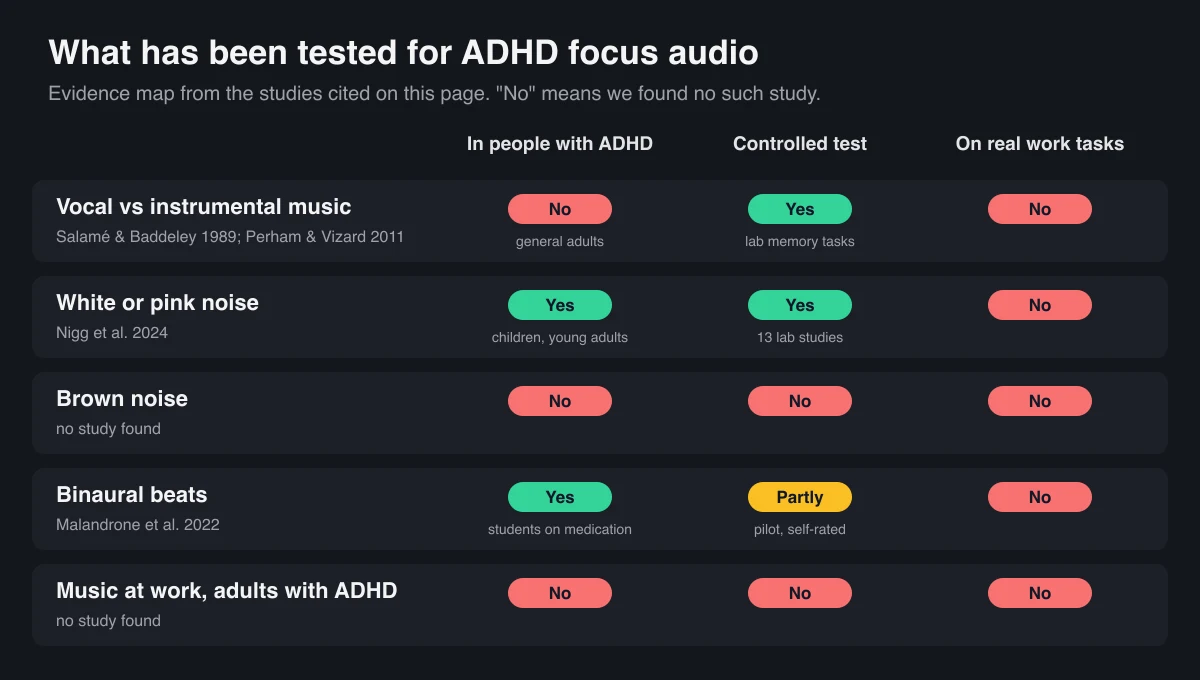
One caveat about the evidence: most studies used children, students or lab memory tasks, not adults working a full day. The lab tasks behind the firmest results were mostly serial recall of digits or lists.
ADHD and music: what the research shows
Most evidence on music for ADHD focus, and on ADHD and music generally, is indirect. In a 2025 survey of 434 young adults aged 17 to 30, the 118 screened as likely to have ADHD reported more background music while studying, and preferred stimulating music more often, than the rest (Lachance et al.). A 2025 review of 20 studies maps ADHD music research; most of its studies report positive effects of music listening, which is not a test of background music on real work (Saville et al.).
| Sound | Studied in | Finding |
|---|---|---|
| Vocal music | General adults, lab recall | Disrupted recall more than instrumental (Salamé and Baddeley, 1989) |
| Liked or disliked music | General adults, lab recall | Both impaired recall equally (Perham and Vizard, 2011) |
| White or pink noise | Children and young adults with ADHD | Small average benefit, g = 0.25 (Nigg et al., 2024) |
| Brown noise | No study found | None |
| Binaural beats | Students on ADHD medication | Preliminary, self-rated (Malandrone et al., 2022) |
ADHD music focus: what kind of music helps
Start with steady, instrumental music with no lyrics, picked before the block begins.
Lyrics compete with verbal memory, so instrumental music for ADHD is the safer start for reading and writing (Salamé and Baddeley, 1989). Focus music for ADHD should also be predictable: in our judgement, abrupt drops and new tracks mid-block, for example a playlist that jumps genres, are a risk.
Pick music for ADHD concentration by predictability. ADHD music for concentration that surprises you competes with the work, so concentration music for ADHD should be dull by design, and so should ADHD concentration music from a streaming mix.
ADHD calming music and ADHD relief music suit breaks. Lyrics are fine for chores.
Brown noise for ADHD: does it help?
We found no controlled study of brown noise for ADHD, so nobody can say yet.
A 2024 meta-analysis of 13 lab studies (335 children and college-age young adults) found a small average benefit of white noise and pink noise on attention tasks with ADHD or elevated symptoms, and a small cost without it (Nigg et al.). White noise ADHD advice therefore rests on young people and short tasks, and white noise for ADHD at work is untested.
A brown noise machine for ADHD (a steady low rumble) or any ADHD white noise track is a trial. In one lab study, steady white noise that dropped out disrupted adults with self-reported ADHD more than adults without (Elbe et al.), so avoid ADHD noise that cuts out mid-block. Use an ADHD sound app only if it stays steady. More in noise and music for coding.
Binaural beats and ADHD
Binaural beats are two slightly different tones, one per ear, that the brain hears as a pulsing third tone. The evidence is early: a pilot in students taking ADHD medication reported better subjective studying with a 15 Hz track than with placebo, and the authors call it preliminary (Malandrone et al.).
Binaural beats for ADHD remain an experiment: claims about ADHD binaural beats and ADHD music binaural beats go beyond what we found, and ADHD sound frequency numbers are no recipe. Healthline advises people with seizures or a pacemaker to ask a clinician first. See binaural beats for coding.
Does music help ADHD students focus?
Unproven: we found no study testing whether music improves focus in students with ADHD. Practical rule: no lyrics during reading and recall practice, free choice for flashcards and tidying notes, such as sorting notes. That is our heuristic.
ADHD-screened young adults report more background music while studying (Lachance et al.), but that describes a habit. For ADHD study music and study music for ADHD, steady instrumental is the safer start. Exams are silent, so check in the log whether your best blocks needed sound at all. For one timed block, see how to stop procrastinating.
ADHD focus music for developers and professionals
Keep the strictest audio for the hardest work. For debugging, reading a stack trace or writing a report, ADHD focus music should be steady and instrumental, or silence, because lyrics compete with verbal memory (Salamé and Baddeley, 1989). Routine work, for example renaming files or filling a form, tolerates more.
If you must notice a page, a phone or a message, use silence or a very quiet steady sound. In an open office or a noisy home, try a steady masking sound first, and set audio at the start of a block, never during it.
Music for ADHD focus at work is a workflow judgement here, and no research tests it. See focus music for developers, lyrics vs instrumental and, for adaptive apps, Brain.fm alternatives.
Test your own ADHD focus music for two weeks
A lane is one audio policy for a block: silence, steady instrumental, a steady masking sound, or music with lyrics. The research cannot tell you which lane suits you, so measure it. Answer four questions and the picker names a starting lane, what to avoid and a stop rule.
Then log each block for two weeks: the task, the lane, a 1 to 5 focus rating, and whether you reached your checkpoint. After five blocks a lane starts to say something. Both tools run in your browser, and the log stays on your device.
Starting policy to test
Steady instrumental, no lyrics, chosen before the block
- Why
- These tasks lean on the same inner voice that vocals compete with. In a serial-recall study vocal music disrupted memory more than instrumental music did (Salamé & Baddeley, 1989). Liking the music did not remove the disruption (Perham & Vizard, 2011). Aim for low surprise, and treat silence as a valid choice.
- Avoid
- Lyrics until you have your own data that they are fine.
- Stop rule
- If after five blocks your focus ratings or finished checkpoints are no better than with silence, drop the lane. Averages in the studies do not tell you which kind of listener you are.
This applies the guide's heuristics to your answers. No study of people with ADHD has validated it.
No blocks yet. Add one after your next block. The summary appears here.
Stored only in this browser, with no account and no network request. The log holds no free text. Clearing site data or using another device starts it over. With a handful of blocks per lane the averages are noisy, and a better number may come from the task, the day or your sleep rather than the audio. Use the table to choose the next week's experiment.
ADD, ADHD and sound sensitivity
ADD is the older name for ADHD, so music for ADD, ADD and music, add focus music and attention deficit disorder music describe the same need as ADHD focus music. Sound sensitivity is a separate question: ADHD and sound sensitivity, ADHD loud noises or any ADHD sound that feels harsh call for quieter, steadier audio or silence.
What we do not know
- Whether any music or noise lane improves output for adults with ADHD over a full workday: no study tests it.
- Whether brown noise does anything for ADHD: no controlled study exists.
- Whether binaural audio improves attention, or the tools on this page change outcomes: unmeasured.
So run the two-week log on your own ADHD focus music, and start with the lane your own results support.
Primary sources and references
These peer-reviewed papers are linked through their DOI records or publisher pages. They support the directional claims in this article; none directly measures long, production-grade software development.
- Lachance, K.-A., Pelland-Goulet, P., & Gosselin, N. (2025). "Listening habits and subjective effects of background music in young adults with and without ADHD." Frontiers in Psychology, 15, Article 1508181.
DOI: 10.3389/fpsyg.2024.1508181
An online survey of 434 young adults aged 17 to 30, 118 of them screened as likely to have ADHD from self-reported symptoms. It compares what people listen to during more and less demanding activities. It measures habits and self-reports, not performance.
- Saville, P., Kinney, C., Heiderscheit, A., & Himmerich, H. (2025). "Exploring the intersection of ADHD and music: A systematic review." Behavioral Sciences, 15(1), Article 65.
DOI: 10.3390/bs15010065
A narrative synthesis of 20 studies (1981–2023) on music performance, music as stimulation, and music-based interventions. Most report positive effects of music listening in various domains. It maps the field; it is not a test of a background-music lane on real work.
- Salamé, P., & Baddeley, A. D. (1989). "Effects of background music on phonological short-term memory." The Quarterly Journal of Experimental Psychology Section A, 41(1), 107–122.
DOI: 10.1080/14640748908402355
In serial recall of digits, vocal music disrupted performance more than instrumental music did.
- Perham, N., & Vizard, J. (2011). "Can preference for background music mediate the irrelevant sound effect?." Applied Cognitive Psychology, 25(4), 625–631.
DOI: 10.1002/acp.1731
In serial recall, liked and disliked music impaired performance about equally. Preference did not remove the disruption.
- Nigg, J. T., Bruton, A., Kozlowski, M. B., Johnstone, J. M., & Karalunas, S. L. (2024). "Systematic review and meta-analysis: Do white noise or pink noise help with task performance in youth with attention-deficit/hyperactivity disorder or with elevated attention problems?." Journal of the American Academy of Child & Adolescent Psychiatry, 63(8), 778–788.
DOI: 10.1016/j.jaac.2023.12.014
The closest controlled evidence for noise and ADHD: 13 studies, 335 children and college-age young adults with ADHD or elevated symptoms, laboratory attention tasks, a small average benefit (g = 0.25) and a small average cost in comparison groups without ADHD. No brown-noise studies were found.
- Elbe, P., Marsh, J. E., Sörman, D., Nyberg, L., Vega-Mendoza, M., & Ljungberg, J. K. (2025). "Differential impacts of addition and omission deviants on the working memory performance of adults with and without self-reported ADHD." Journal of Cognitive Psychology (advance online publication), 1–16.
DOI: 10.1080/20445911.2025.2563538
A laboratory study of 66 adults with self-reported ADHD and 66 without: steady white noise that dropped out disrupted the ADHD group more, while sound being added disrupted the other group more.
- Malandrone, F., et al. (2022). "A pilot add-on randomized-controlled trial evaluating the effect of binaural beats on study performance, mind-wandering, and core symptoms of adult ADHD patients." European Psychiatry, 65(S1), S274 (conference abstract).
DOI: 10.1192/j.eurpsy.2022.701
A small pilot in university students taking ADHD medication: subjective studying performance improved with a 15 Hz binaural-beat track compared with a placebo track. The authors call the findings preliminary.
Frequently asked questions
Does music help with ADHD?
Sometimes, for some people. Studies are mixed: survey respondents screened for ADHD report more background music while studying, white or pink noise shows a small average benefit in young people on lab tasks, and no study shows a music lane improving a full workday. Test it with a lane and a log.
Do people with ADHD focus better with music?
Not reliably. Young adults screened for ADHD report using more background music while studying, but that is a habit that does not show it helps, and surveys do not measure performance. Some people focus better with steady instrumental music, others with silence. A two-week log shows which one you are.
Is it scientifically proven that music helps ADHD focus?
No. Reviews find music studied as stimulation and self-regulation in ADHD, but we found no study showing that a background-music lane improves attention on real work. The firmest results are about interference: lyrics and changing sound compete with verbal memory. Noise and binaural claims are earlier still.
Do ADD people focus more with background music?
ADD is the older name for ADHD, and the answer is the same: some do, some do not. Survey data show people screened for ADHD use background music more often while studying, but not that it helps. Pick steady instrumental audio before the block and test it for two weeks.