What is rejection sensitive dysphoria?
Rejection sensitive dysphoria is extreme emotional pain triggered by the sense of being rejected, criticised, or of having failed, whether or not the rejection was real. “Dysphoria” comes from the Greek for “hard to bear.” The meaning of RSD in ADHD is that specific pattern: a fast, overwhelming reaction to social pain, usually described by people who have ADHD.
The term was popularised by the psychiatrist William Dodson in clinical talks and articles for ADHD readers, and it spread through ADHD communities online. It is not a diagnosis. You will not find RSD in the DSM-5-TR or in ICD-11, and it has no official criteria. A 2026 scoping review described it plainly as “not an established research construct” (van Asselt et al., 2026).
That does not make the experience imaginary. It means the label sits on top of two things researchers have studied for decades: rejection sensitivity, a measurable tendency to “anxiously expect, readily perceive, and overreact to” rejection (Downey & Feldman, 1996), and emotional dysregulation, which is common and strong in adults with ADHD. RSD, rejection dysphoria, rejection sensitivity in ADHD and “RSD ADHD” are all names people use for the overlap.
You may also see it misspelled as “rejection sensory dysphoria,” “reactive sensitivity dysphoria” or “rejection syndrome.” These all refer to the same idea; it has nothing to do with sensory processing.
Is RSD real? What the research actually shows
The reaction is real and well described, but RSD as a separate condition is not established. The strongest evidence is for emotional dysregulation in adult ADHD and for rejection sensitivity as a trait; the weakest is for RSD-specific prevalence figures and RSD-specific medication.
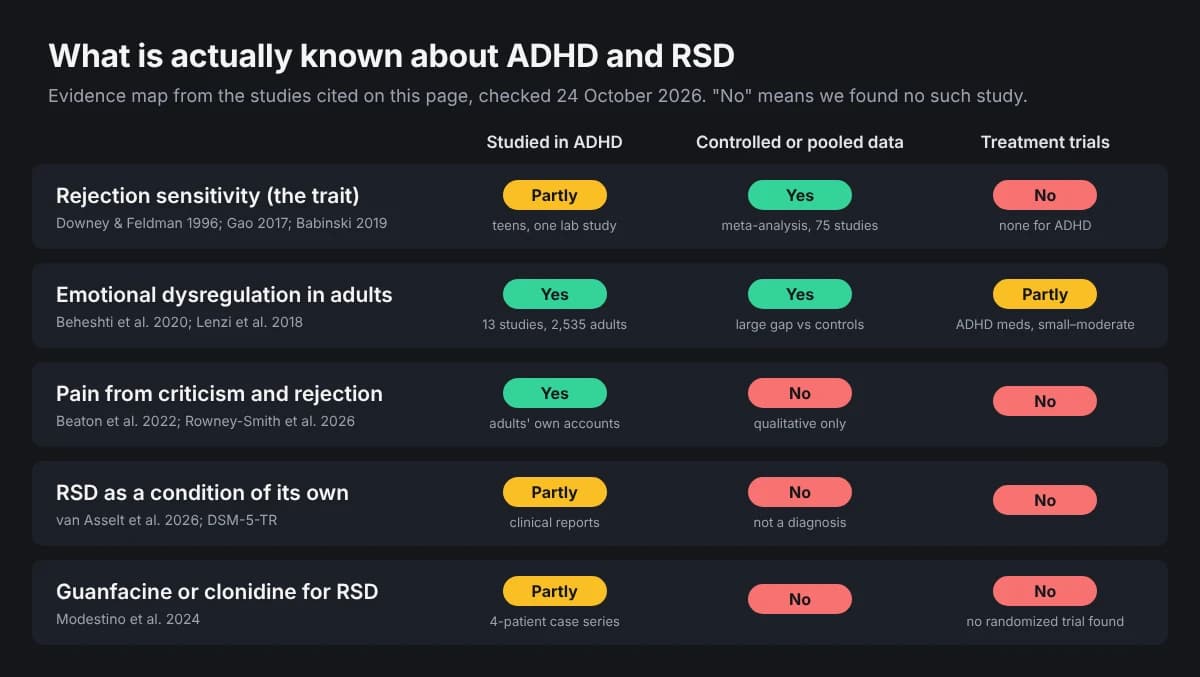
- Emotional dysregulation in adult ADHD is well supported. A meta-analysis of 13 studies and 2,535 people found adults with ADHD had much higher emotion dysregulation than controls, a large effect (g = 1.17), and the more severe the ADHD symptoms, the more dysregulation (Beheshti et al., 2020). A major review calls it a major contributor to impairment across the lifespan (Shaw et al., 2014).
- The link to rejection specifically has early support. In 391 adolescents, more ADHD symptoms went with a stronger brain response to peer rejection, higher self-reported rejection sensitivity, and a weaker response to being accepted (Babinski et al., 2019). That is one cross-sectional study in teenagers, not adults.
- Adults with ADHD describe criticism as unusually painful. In written accounts from 162 adults, criticism damaged self-worth and wellbeing (Beaton et al., 2022). University students with ADHD described withdrawal, masking and strong bodily sensations (Rowney-Smith et al., 2026).
- The famous numbers are not from studies. Claims that RSD affects “99% of people with ADHD,” or that children with ADHD hear “20,000 more negative messages” by age 12, trace back to clinical estimates and talks, not to published data. We could not find a study behind either. Treat them as impressions.
So when someone says “RSD isn’t real,” they are right that it is not a diagnosis, and wrong if they mean the experience is made up. When someone says “RSD is a core ADHD symptom,” they are ahead of the evidence.
Signs and symptoms of RSD
The main sign of RSD is a reaction to rejection or criticism that comes on within seconds, feels physical and overwhelming, and is far bigger than the event that caused it. Because RSD has no official criteria, these are the patterns clinicians and people with ADHD describe most often, not a checklist.
- A sudden emotional wave of shame, despair, rage or panic after a remark, a rejection, or a perceived failure, often before you can explain why.
- Physical symptoms: heat in the face, a tight chest, a lump in the throat, crying, nausea.
- Reading rejection into neutral signals, such as a short reply, a delayed answer, a sigh, or a changed meeting.
- Rumination: replaying the moment for hours, rewriting what you should have said.
- Lashing out or shutting down, sometimes both in the same afternoon.
- Avoidance: not applying, not sharing work, not asking, so that no one can say no.
- People-pleasing, or perfectionism and overwork, so there is nothing to criticise.
- A quick end: the wave often passes as fast as it came, leaving embarrassment about the reaction.
In adults, RSD more often looks like overwork, silence and avoided emails than like visible tears. In children and teens it can look like meltdowns after small corrections, quitting activities after one setback, or refusing to try something new. Because masking is common, the people around you may never see the episode at all.
What an RSD episode looks like: five examples
An episode has three parts: a trigger, which is often small or ambiguous; an inner reaction, which is fast and intense; and what other people see, which is often withdrawal or a sharp response. These examples show the gap between the three.
| Trigger | What it feels like inside | What others see |
|---|---|---|
| Your manager writes “Can we talk tomorrow?” with no context | Instant dread; you are sure you are about to be fired and spend the evening rehearsing | You seem distracted at dinner; next day it was about holiday dates |
| A friend takes six hours to answer a message | A heavy, sinking feeling; “they are tired of me” | You go quiet, or send three more messages, or cancel your plans first |
| A reviewer leaves 14 comments on your pull request | Heat in the face, a lump in the throat, the urge to quit the job | You don’t open the PR for two days, then rewrite far more than was asked |
| A partner sighs while you tell a story | Shame, then anger; you replay it for an hour | A sharp reply, or you stop talking mid-sentence |
| You are not invited to a lunch | Proof, in the moment, that nobody really likes you | You skip the next team event so you can’t be left out again |
Notice that in most rows nothing rejecting actually happened. That is what researchers mean by “readily perceive”: the alarm fires on ambiguity. It is also why the coping steps below start with separating what was said from what you heard.
RSD at work and at school
At work and at school, RSD mostly costs time: the hours after feedback when you can’t start anything, the task you avoid because it was criticised once, and the extra work you do so nobody can find fault. The emotional spike passes; the avoided task stays.
Feedback is built into most jobs now: code review, performance reviews, edits on a draft, grades, comments in a shared document. For someone with rejection sensitivity, each is a small trigger. In the study of adults with ADHD and criticism, inattentive behaviour (missed details, lateness, forgotten tasks) drew the most criticism (Beaton et al., 2022), which is exactly the kind of feedback a workplace produces.
Common patterns:
- The frozen inbox. You see a reply from your manager and don’t open it for hours, because not knowing feels safer.
- The post-review stall. After a critical review you can’t touch the project for a day, then rewrite far more than was asked.
- The over-polish. You won’t submit until it is perfect, so it is late, which brings the criticism you were avoiding.
- The silent meeting. You don’t share an idea because it might be dismissed.
- The quit fantasy. One bad comment and you are drafting a resignation, or a decision to drop the course.
If these sound familiar, the problem to solve on a work day is usually re-entry: how to get back into the task after the spike. That is covered in the worked example below, and the general version in how to stop procrastinating.
RSD vs social anxiety, depression and borderline personality disorder
RSD is a reaction after a perceived rejection; social anxiety is fear before and during social situations; depression is low mood that lasts for weeks. They overlap, and rejection sensitivity is linked to all of them, so a strong reaction to rejection is a reason to get assessed, not a reason to self-label.
A meta-analysis of 75 studies found rejection sensitivity moderately associated with depression, anxiety, loneliness and borderline personality disorder (Gao et al., 2017). That is also why “RSD without ADHD” is a real search: the reactions are not unique to ADHD.
| Condition | When it shows up | Typical shape | Status |
|---|---|---|---|
| RSD as described in ADHD | After a perceived rejection, criticism or failure | Sudden and intense; often fades within hours | Not a diagnosis; described by clinicians and people with ADHD |
| Social anxiety disorder | Before and during social situations | Ongoing fear of being judged; avoidance in advance | A DSM-5 diagnosis; CBT has strong evidence |
| Depression | Most of the day, most days, for two weeks or more | Low mood or loss of interest that does not lift with good news | Rejection sensitivity is a listed feature of the atypical subtype |
| Borderline personality disorder | Around fear of abandonment in close relationships | Intense, unstable relationships, identity and mood | Strongly linked to rejection sensitivity; DBT was built for it |
| Autism | Varies; often after social misunderstandings | Can include strong reactions to rejection and social pain | Under-studied; see the 2026 scoping review |
The practical point: if low mood lasts most days for two weeks or more, or if fear of social situations keeps you from them in advance, that is not “just RSD,” and it has treatments with stronger evidence than anything written about RSD.
Is there a test for rejection sensitive dysphoria?
There is no validated test for RSD, because there is no agreed definition to validate it against. Researchers measure the broader trait with the Rejection Sensitivity Questionnaire, and clinicians assess RSD by interview. Online RSD tests, including the one below, can show patterns but cannot diagnose.
The self-check below lists ten patterns from published descriptions of rejection sensitivity. Answer for the last few months, not for your worst day. It works best as a way to put words to what happens, which is useful if you decide to talk to someone about it.
Your summary
0 of 10 answered
Answer every line for a summary. Nothing you pick leaves this page.
A reflection list built from published descriptions of rejection sensitivity. It is not a validated scale and cannot tell you whether you have RSD, ADHD or anything else. Your answers are not stored or sent. If you are having thoughts of harming yourself, call or text 988 in the US, or your local emergency number, now.
What causes RSD in ADHD?
Nobody knows for certain. The two leading explanations are that RSD is one face of the emotional dysregulation common in ADHD, and that years of criticism for ADHD traits teach the brain to expect rejection. Both probably contribute.
- Emotion regulation. One review suggests emotional dysregulation in ADHD may come from differences in how attention is directed toward and away from emotional signals (Shaw et al., 2014). If you can’t easily shift attention off a painful signal, it stays loud.
- A history of criticism. Inattentive and impulsive behaviour draws correction at home, at school and at work, and adults with ADHD report that it damaged their self-worth (Beaton et al., 2022). In the original rejection sensitivity research, the trait was linked to earlier experiences of rejection (Downey & Feldman, 1996).
- Reward and acceptance. Teens with more ADHD symptoms reacted less to being accepted, not only more to being rejected (Babinski et al., 2019). If praise registers weakly and criticism strongly, the balance tilts.
- Everything that lowers the threshold. Poor sleep, stress, hunger, hormonal changes and the end of a medication dose are commonly reported to make episodes more likely. That is self-report, but it is cheap to test on yourself.
How to cope with RSD in the moment: a seven-step plan
To cope with an RSD episode, calm your body before you argue with your thoughts, delay any reply or decision for an hour, then check what was actually said against what you heard, and return to one small task. The steps are short so you can use them while the wave is still high.
No trial has tested these steps on RSD. Each one is based on emotion regulation research in the general population and on what therapists teach for intense emotions. Save this section, or copy it to your phone, before you need it.
1. Name it
Say or write, “This is a rejection spike.” Putting a feeling into words reduced the brain’s alarm response in a lab study of healthy adults (Lieberman et al., 2007). It also reminds you that you have been here before and it passed.
2. Body before thoughts
For the first few minutes, don’t argue with the story in your head. Slow your breathing so the out-breath is longer than the in-breath, splash cold water on your face, or walk around the block. The goal is to get out of the spike before you decide anything.
3. Set a one-hour rule
No replies, no resignations, no deleting your account, no “fine, I’ll do it all myself” for one hour. Write the message if you must, but keep it in drafts. Most of the damage from an episode comes from what is sent during it.
4. Write down what was actually said
Copy the exact words of the message or remark, then underneath write what you added: the tone you heard, the meaning you assumed. Rejection sensitivity is, by definition, a tendency to read rejection into ambiguous signals (Downey & Feldman, 1996), so separating the words from the reading is the core skill.
5. List three other explanations
They were busy. They write short messages to everyone. The criticism was about the document, not about you. This is reappraisal, and in a meta-analysis of emotion regulation experiments it changed how people felt more than holding the feeling in did (Webb et al., 2012).
6. Ask, don’t guess
When the hour is up, check the reading with the person if it matters: “I want to make sure I understood your note. Is the main problem the structure, or the numbers?” A question gets you facts; a defensive reply gets you a second conflict.
7. Do one small, concrete task
After a rejection, the next task is the hardest to start. Pick something you can finish in 15 minutes, write what “done” looks like, and start a timer. Finishing anything gives your attention somewhere to go other than the replay loop.
The one-line version: name it, breathe, wait an hour, write what was really said, find three other explanations, ask, then do one 15-minute task.
Managing rejection sensitive dysphoria over time
Over months, RSD usually gets easier through four things: treating the ADHD itself, learning emotion regulation skills in therapy, changing how feedback reaches you, and keeping a record that shows episodes pass. None of these is a cure, and progress is uneven.
- Therapy that teaches skills. CBT and DBT both work on noticing emotional spikes, tolerating them and responding differently. In a randomized trial of a DBT-based skills group for adults with ADHD, executive function, ADHD symptoms and quality of life improved more than with usual care and held at six months; emotion regulation scores did not differ between groups at the end of the 14 weeks (Halmøy et al., 2022). So skills help, but there is no RSD-specific therapy with trial evidence yet.
- Ask for feedback in a form you can handle. Written feedback lets you read it after the spike, not during. Ask for the one most important change first. Agree with your manager that “can we talk?” always comes with a topic.
- Tell one or two people. In the criticism study, being understood shaped whether a remark felt like criticism at all (Beaton et al., 2022). A partner or colleague who knows can say “that wasn’t about you” at the right moment.
- Keep an episode log. Date, trigger, peak intensity from 1 to 10, how long it lasted, and what turned out to be true. After a month, the log shows the triggers and, usually, that the feared outcome rarely happened. It is also exactly what a clinician wants to see.
- Protect the basics. Sleep, food and fewer back-to-back demands raise the threshold. It is unglamorous advice, and people with ADHD report it matters.
- Separate the task from the verdict. Feedback about a task is information; feedback about you is a judgement. In a meta-analysis of 607 feedback effects, feedback that directed attention to the self tended to make performance worse, while feedback about the task tended to help (Kluger & DeNisi, 1996). Practise translating “you’re careless” into “three numbers in table 2 were wrong.”
RSD treatment and medication: what is known
There is no approved treatment for RSD and no randomized trial of any treatment for it. ADHD medications reduce emotional dysregulation by small to moderate amounts in trials, and some clinicians report that guanfacine or clonidine help with rejection sensitivity, based on practice experience rather than trials.
Here is what the evidence looks like, from strongest to weakest:
- Standard ADHD medication. In double-blind trials in adults with ADHD, methylphenidate, atomoxetine and lisdexamfetamine all reduced emotional dysregulation, by small to moderate amounts, less than they reduce attention symptoms (Lenzi et al., 2018). If you have ADHD and it is untreated, treating it is the best-supported first step.
- Guanfacine and clonidine. These alpha-2 agonists are approved for ADHD in some countries. Dodson and colleagues report that some patients’ rejection sensitivity improves on them; the published support is a four-patient case series (Modestino et al., 2024). Searches such as “guanfacine for rejection sensitive dysphoria” are common, but we found no randomized trial.
- MAO inhibitors. Occasionally mentioned in clinical talks for RSD. They have serious interactions with food and other medicines and are rarely used; this is specialist territory only.
- “Natural treatment.” No supplement has evidence for RSD. Sleep, exercise and lower stress are worth doing for their own sake; anything sold as a natural RSD cure is selling more than the evidence supports.
This page cannot tell you what to take. Medication decisions belong with a prescriber who knows your history, especially if you already take something. Useful things to bring: your episode log, your answers to the self-check, and a note of how episodes affect your work and relationships.
How to help someone with RSD
To help a partner, child, friend or employee with RSD, be clear and specific, give context before criticism, keep feedback about the task rather than the person, and don’t take the first reaction as the final one. You don’t have to avoid all criticism; you have to make it unambiguous.
- Remove the ambiguity. “Can we talk at 3 about the launch dates? Nothing’s wrong” beats “can we talk?”
- Name the task, not the trait. “The summary needs the cost figure” rather than “you always miss things.”
- Lead with the one thing. One main change, then the details in writing.
- Allow time. If they go quiet or react sharply, give it an hour and come back. Most episodes pass.
- Say the good part out loud. If acceptance registers more weakly, it is worth saying plainly.
- For parents: correct the behaviour in private, keep it short, and separate it from your affection: “That’s not OK, and I’m not angry with you.”
Worked example: getting back to work after a harsh code review
Here is the in-the-moment plan on a real kind of trigger. Sam, a developer with ADHD, opens a pull request at 11:40 and finds 14 comments, two of them blunt. Without a plan, the usual outcome is a lost afternoon and a 2 am rewrite.
- 11:40, name it. Sam types in a notes file: “Rejection spike, review on PR #212.” Closes the tab.
- 11:42, body first. Water, a walk to the end of the street and back.
- 11:55, one-hour rule. A defensive reply sits in drafts, unsent.
- 12:00, facts. Sam copies the comments into the notes file and sorts them: 9 are nits, 3 are real issues, 2 are about naming. The blunt ones are about a function, not about Sam.
- 12:05, one small task. Sam starts a 15-minute block: goal “fix the first real issue, nothing else,” done when “one comment resolved and pushed; reply drafted, not sent.”
- 13:00, ask. After lunch, Sam replies to the one comment that was unclear with a question, not a defence.
The episode still happened. What changed is that it cost 25 minutes instead of a day, and nothing was sent at the peak. For more on picking up a coding task after an interruption, see why developers lose focus and how to get it back.
Where NEDIO fits, and where it doesn’t
NEDIO is a focus timer in the browser, and it covers step 7 only: getting back into one small task. You write a goal and a “done when” line, pick a short block, and work with instrumental audio. A close-out at the end records what you finished and where to pick up. Sprints of 15, 25, 45, 60 or 90 minutes and breaks of 3, 5, 10 or 15 minutes, on every plan. The default is 25 minutes with a 5-minute break, and a longer break (3 times the chosen break, 15 minutes by default) after every fourth block.
One design choice is relevant here. NEDIO’s weekly recap talks about tasks and counts, such as how many blocks landed their goal, and never about what kind of person you are. That follows the feedback research above, and it means the tool won’t add another verdict to your week. NEDIO does not check whether your goal was reached or whether your code works. It records what you tell it.
It does not treat RSD, ADHD or anything else, and it makes no claim to. If a kitchen timer and a sheet of paper get you back to work, they do the same job.
When to get professional help
See a doctor, psychologist or psychiatrist if rejection reactions are damaging your relationships or work, if you suspect ADHD that has never been assessed, or if episodes come with low mood that lasts. Get help now if you have thoughts of harming yourself.
- Episodes cost you jobs, courses, friendships or relationships.
- You avoid applying, sharing work or meeting people because of possible rejection.
- Low mood, hopelessness or anxiety last for weeks, not hours.
- You think you might have ADHD and have never been assessed, or your treatment has stopped working.
- You have thoughts of suicide or self-harm. In the US, call or text 988 (Suicide & Crisis Lifeline). Elsewhere, call your local emergency number or a crisis line.
A good assessment looks at ADHD, mood, anxiety and personality together, because they overlap. Bring examples: the episode log and the self-check answers are more useful than “I’m too sensitive.”
Conclusion
ADHD RSD is a name for something many people with ADHD know well: a sudden, physical, outsized reaction to rejection or criticism. It is not a formal diagnosis, and the popular statistics outrun the research, but the emotional dysregulation underneath it is well documented. You can’t stop the first wave by deciding to. You can shorten what follows: name it, calm your body, wait before acting, check the facts, and get back into one small task. Over time, ADHD treatment, skills-based therapy and clearer feedback make the waves smaller.
Primary sources and references
These peer-reviewed papers and reports are linked through their DOI records. Most come from studies of emotional dysregulation and rejection sensitivity in general; research on RSD as its own condition is still thin, so treat the directional claims in this guide as the best current reading, not settled fact.
- Downey, G., & Feldman, S. I. (1996). "Implications of rejection sensitivity for intimate relationships." Journal of Personality and Social Psychology, 70(6), 1327–1343.
DOI: 10.1037/0022-3514.70.6.1327
The paper that defined rejection sensitivity as a tendency to anxiously expect, readily perceive and overreact to rejection, and introduced a questionnaire to measure it. People high in it read intentional rejection into ambiguous behaviour.
- Gao, S., Assink, M., Cipriani, A., & Lin, K. (2017). "Associations between rejection sensitivity and mental health outcomes: A meta-analytic review." Clinical Psychology Review, 57, 59–74.
DOI: 10.1016/j.cpr.2017.08.007
Pooled 75 studies. Rejection sensitivity was moderately associated with depression (r = 0.33), anxiety (r = 0.41), loneliness (r = 0.39) and borderline personality disorder (r = 0.41). Associations, not causes.
- Babinski, D. E., Kujawa, A., Kessel, E. M., Arfer, K. B., & Klein, D. N. (2019). "Sensitivity to peer feedback in young adolescents with symptoms of ADHD: Examination of neurophysiological and self-report measures." Journal of Abnormal Child Psychology, 47(4), 605–617.
DOI: 10.1007/s10802-018-0470-2
In 391 community adolescents aged 10 to 15, more ADHD symptoms went with a stronger brain response to peer rejection, higher self-reported rejection sensitivity, and a weaker response to acceptance. Cross-sectional.
- Beheshti, A., Chavanon, M.-L., & Christiansen, H. (2020). "Emotion dysregulation in adults with attention deficit hyperactivity disorder: A meta-analysis." BMC Psychiatry, 20, Article 120.
DOI: 10.1186/s12888-020-2442-7
Pooled 13 studies with 2,535 participants. Adults with ADHD showed much higher emotion dysregulation than controls (Hedges’ g = 1.17), and it rose with ADHD symptom severity (r = 0.54).
- Shaw, P., Stringaris, A., Nigg, J., & Leibenluft, E. (2014). "Emotion dysregulation in attention deficit hyperactivity disorder." American Journal of Psychiatry, 171(3), 276–293.
DOI: 10.1176/appi.ajp.2013.13070966
A review concluding that emotion dysregulation is common in ADHD across the lifespan and a major source of impairment, and weighing whether it is a core feature of ADHD or a separate, overlapping problem.
- Beaton, D. M., Sirois, F., & Milne, E. (2022). "Experiences of criticism in adults with ADHD: A qualitative study." PLOS ONE, 17(2), e0263366.
DOI: 10.1371/journal.pone.0263366
162 adults with ADHD or high ADHD traits wrote about criticism. Inattentive behaviour drew the most of it, it hurt self-worth and wellbeing, and being understood by others shaped whether a remark felt like criticism at all.
- Rowney-Smith, A., Sutton, B., Quadt, L., & Eccles, J. A. (2026). "The lived experience of rejection sensitivity in ADHD: A qualitative exploration." PLOS ONE, 21(1), e0314669.
DOI: 10.1371/journal.pone.0314669
Focus groups with five university students with ADHD. Three themes: withdrawal, masking, and bodily sensations. Exploratory and very small, but it matches what clinicians describe.
- van Asselt, A., Reekers, D., & Roke, Y. (2026). "Rejection sensitivity dysphoria in autistic adults: A scoping review." Neurodiversity (SAGE).
DOI: 10.1177/27546330261441753
Describes RSD as not an established research construct, with a fragmented evidence base, so the authors had to borrow adjacent ideas such as social pain and ostracism distress. Its subject is autistic adults, not ADHD.
- Modestino, E. J., Dodson, W., et al. (2024). "Rejection sensitivity dysphoria in attention-deficit/hyperactivity disorder: A case series." Acta Scientific Neurology, 7(8).
DOI: 10.31080/ASNE.2024.07.0762
Four patients from one private practice, described in detail, including responses to alpha-2 agonists. A case series cannot show that a drug works; it is listed here because it is the most cited published source for the medication claims.
- Lenzi, F., Cortese, S., Harris, J., & Masi, G. (2018). "Pharmacotherapy of emotional dysregulation in adults with ADHD: A systematic review and meta-analysis." Neuroscience & Biobehavioral Reviews, 84, 359–367.
DOI: 10.1016/j.neubiorev.2017.08.010
Across double-blind trials, methylphenidate (SMD 0.34), atomoxetine (0.24) and lisdexamfetamine (0.50) reduced emotional dysregulation by small to moderate amounts, less than they reduce core ADHD symptoms.
- Halmøy, A., Ring, A. E., Gjestad, R., et al. (2022). "Dialectical behavioral therapy-based group treatment versus treatment as usual for adults with attention-deficit hyperactivity disorder: A multicenter randomized controlled trial." BMC Psychiatry, 22, Article 738.
DOI: 10.1186/s12888-022-04356-6
In a 14-week trial, a DBT-based skills group improved executive function, ADHD symptoms and quality of life more than usual care, with gains held at six months. Emotion regulation scores did not differ between groups at 14 weeks.
- Lieberman, M. D., Eisenberger, N. I., Crockett, M. J., Tom, S. M., Pfeifer, J. H., & Way, B. M. (2007). "Putting feelings into words: Affect labeling disrupts amygdala activity in response to affective stimuli." Psychological Science, 18(5), 421–428.
DOI: 10.1111/j.1467-9280.2007.01916.x
Naming the emotion in a picture reduced amygdala activity compared with other ways of looking at it. A lab study in healthy adults; the basis for step 1 of the in-the-moment plan, not proof that it works for RSD.
- Webb, T. L., Miles, E., & Sheeran, P. (2012). "Dealing with feeling: A meta-analysis of the effectiveness of strategies derived from the process model of emotion regulation." Psychological Bulletin, 138(4), 775–808.
DOI: 10.1037/a0027600
A meta-analysis of 306 experimental comparisons. Reappraising the situation changed emotional outcomes more than suppressing the expression of an emotion did. General population, not ADHD.
- Kluger, A. N., & DeNisi, A. (1996). "The effects of feedback interventions on performance: A historical review, a meta-analysis, and a preliminary feedback intervention theory." Psychological Bulletin, 119(2), 254–284.
DOI: 10.1037/0033-2909.119.2.254
Across 607 effects, more than a third of feedback interventions made performance worse. Feedback that pulled attention to the self did harm; feedback about the task helped. The basis for the advice on giving feedback.
Frequently asked questions
What does RSD mean in ADHD?
RSD stands for rejection sensitive dysphoria: sudden, intense emotional pain triggered by real or perceived rejection, criticism or failure. The term is used mostly about people with ADHD. It describes an experience many people report; it is not a diagnosis in the DSM-5-TR or ICD-11.
Is RSD a symptom of ADHD?
It is not one of the official ADHD criteria. What research does show is that emotional dysregulation is common and strong in adults with ADHD, and that teens with more ADHD symptoms react more strongly to peer rejection. Many clinicians see RSD as one face of that dysregulation.
Can you have rejection sensitive dysphoria without ADHD?
Yes, the reactions described as RSD are not exclusive to ADHD. Rejection sensitivity is measured in the general population and is linked to depression, anxiety, loneliness, borderline personality disorder and autism. The label RSD is simply used most often in ADHD circles.
Is there a test for rejection sensitive dysphoria?
No validated test for RSD exists, because RSD has no agreed definition. Researchers measure the broader trait with the Rejection Sensitivity Questionnaire. Online RSD quizzes, including the self-check on this page, can help you notice patterns but cannot diagnose anything. A clinician assesses it by interview.
What medication helps rejection sensitive dysphoria?
No medication is approved for RSD and no randomized trial has tested one for it. Some clinicians report that guanfacine or clonidine helps, based on practice experience. ADHD medications reduce emotional dysregulation by small to moderate amounts in trials. Discuss any option with your prescriber.
How do I calm down during an RSD episode?
Name what is happening (“this is a rejection spike”), calm your body first with slow breathing or a short walk, and make a rule not to reply, quit or send anything for an hour. Then write down what was actually said, list other explanations, and return to one small task.
Does RSD go away?
Episodes usually pass within hours, though they can feel endless. The tendency itself often eases with ADHD treatment, therapy that builds emotion regulation skills, fewer triggers in daily life, and supportive relationships. There is no long-term study of RSD specifically, so nobody can give you odds.
Is RSD the same as social anxiety?
No. Social anxiety is mostly fear before and during social situations, and it lasts. RSD as described is a sudden, intense reaction after a perceived rejection, which often fades quickly. The two can overlap, and rejection sensitivity is linked to anxiety, so a clinician should tell them apart.
Why does RSD make me cry so easily?
People describe RSD as a physical wave: heat, a tight chest, tears, sometimes before they understand what upset them. Adults with ADHD in one study described exactly these bodily sensations. Crying is a normal stress response, not a weakness; the in-the-moment steps help it pass faster.
Is rejection sensitive dysphoria in the DSM-5?
No. RSD is not a diagnosis in the DSM-5-TR or ICD-11 and has no official criteria. Clinicians who use the term use it descriptively. Rejection sensitivity does appear in the DSM-5 as a feature of depression with atypical features, which is one reason assessment matters.