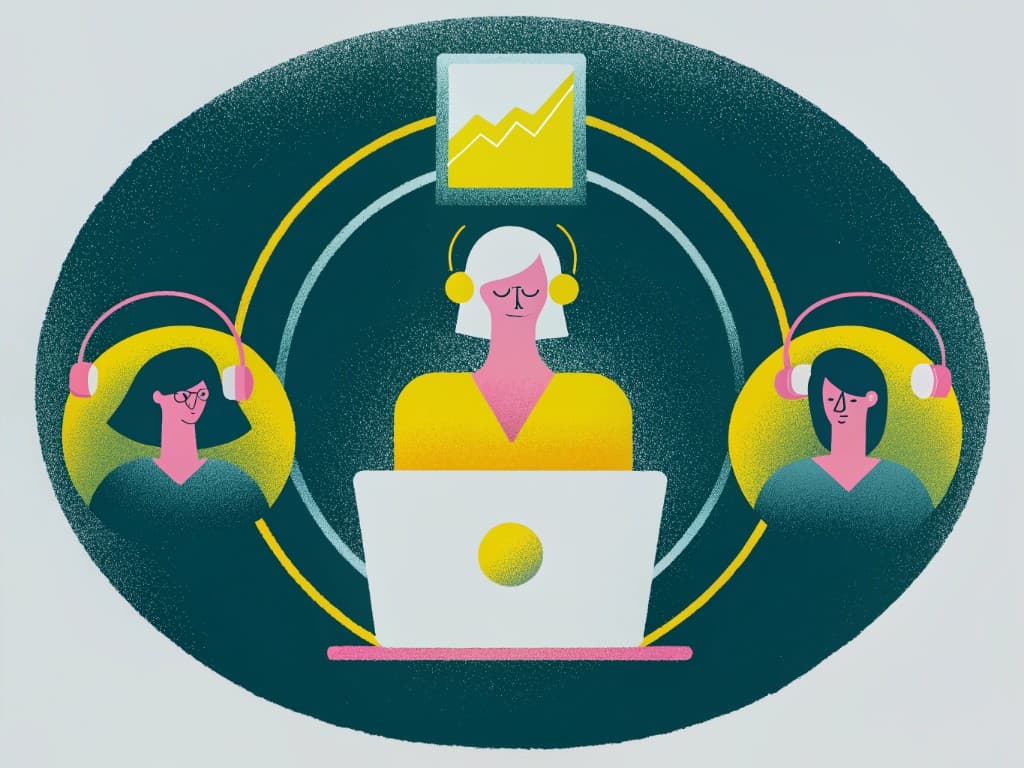
Start here if…
…you can name your deep-work task but cannot protect ninety minutes on the calendar. Fix the calendar and team norms first. Music cannot negotiate boundaries with your manager.
…you can protect time, but your headphones keep pulling you into browsing. That is an app-shape problem: streaming UX vs generative continuity vs a sprint tab that bundles audio with a timer.
The short answer
The best music apps for deep work are the ones that keep acoustic surprise low, keep verbal competition low when you are reading or debugging, and keep UI detours low when you are fragile at session start. Everything else is taste.
How this differs from deep work guides
NEDIO’s deep work guides cover routines, rituals, career-stage realities, and context switching. Those pages are about designing a life that can host deep work. This page is narrower: given you already decided to pursue deep work, which music app categories match common failure modes?
That distinction matters because “best music app” searches often arrive too early—before the user admits their calendar is impossible. If that is you, bookmark this page, fix one boundary, then return.
What deep-work audio is not
Deep-work audio is not a substitute for sleep. It is not therapy. It is not a guarantee of flow state. It is a sensory layer that can make sustained attention easier for some people in some environments—often by reducing external unpredictability or by providing a steady rhythmic scaffold.
Meditation and sleep apps can support baseline regulation, but they do not automatically create a defended maker block. If you are comparing wellness audio to coding audio, read Calm vs NEDIO for an honest category split.
Deep-work audio also should not be treated as a performance enhancer with guaranteed effect sizes. Individual variation is large; environmental variation is larger. The ethical stance is experimentation with humility: try a lane, measure outcomes, discard what fails—without turning your playlist into superstition. If nothing helps, silence remains a respectable control condition for serious experiments in your environment.
Streaming for long blocks
Spotify and Apple Music can absolutely work for deep work when you treat them as utilities rather than discovery engines. The winning pattern is often a small set of trusted instrumental playlists, downloads for offline stability, and autoplay settings that do not surprise you mid-debug.
The failure mode is tab debt and recommendation loops. Deep work needs a boring on-ramp. If your first ten minutes include searching for “the right vibe,” you are not in deep work yet—you are DJ-ing.
For direct NEDIO comparisons, read Spotify vs NEDIO and Apple Music vs NEDIO.
Adaptive and functional audio
Brain.fm and Endel represent a different bet: less catalog browsing, more generated continuity. For long sessions, that can mean fewer novelty spikes that pull attention. Some developers report fatigue from generative sound; others report relief from skipping tracks.
Treat claims carefully—marketing often outruns personal fit. The practical test is whether your deep-work block has lower tab switches and fewer “let me find another album” moments across two weeks, not whether a logo sounds science-y.
Compare directly with Brain.fm vs NEDIO and Endel vs NEDIO, and scan alternatives lists if you want peer products.
Masking and sensory load
In open offices and home environments with unpredictable noise, music might be the wrong tool. Masking generators and steady noise can reduce the brain’s need to predict the next acoustic shock. That is not “more focus music”—it is environmental control.
If you suspect this is your bottleneck, prioritize noise and masking research over playlist culture. Deep work is fragile when your nervous system is busy bracing for the next slamming door.
Bundled sprint rituals
NEDIO bundles instrumental audio with a sprint timer and session proof. For deep work, bundling is not automatically better—but it can be better when your deep-work failure mode is starting, not acoustics. If you sit down and immediately open three tabs to “set the mood,” a single sprint-shaped surface can reduce activation energy.
This is also where “deep work” meets engineering reality: many deep-work blocks are not infinite—they are ninety-minute attempts inside a day of meetings. A sprint log can be a more honest artifact than listening minutes when you review what actually happened.
Calendar and boundaries first
If you read this far and still have no recurring deep-work window, scroll back to routines and protecting focus at work and context switching in software development. The best music app cannot invent a boundary your team refuses to respect.
When the calendar is plausible, return here and run a two-week trial: hold the task type constant, change only the audio layer, and log one meaningful output per block. Deep work is judged by shipped substance, not by headphone brand.
Metrics that lie
Deep work is easy to fake with vanity metrics. “Hours in headphones” is not deep work if those hours were fragmented or spent thrashing. Music apps that report listening time can accidentally reward the wrong behavior: staying in the app, not finishing the hard subtask.
Prefer outcome-linked logs: commits merged, tests added, bugs fixed, reviews completed—whatever matches your role. If your audio layer correlates with better outcomes across two weeks, keep it. If it only correlates with feeling busy, drop it.
For measurement pitfalls more broadly, read measurement and self-report pitfalls for developers. Good metrics respect attention residue and partial progress; bad metrics shame you for being human.
Solo vs collaborative deep work
Not all deep work is solo typing. Pair programming, mobbing, and collaborative design sessions are cognitively demanding too—and they have different audio norms. What works for solo debugging may be rude or counterproductive in a pair.
If your deep work is collaborative, prioritize communication clarity over personal focus audio. Sometimes the right move is shared silence, a single low-information background, or no background at all. The “best music app for deep work” might be “none during the session.”
For developers whose deep work is mostly solo, the recommendations in this article apply more directly. If your role is mostly meetings, the bottleneck is rarely Brain.fm—it is schedule design.
Energy rhythms and chronotypes
Deep work is easier in some hours than others for most humans. If you force hard thinking at your lowest-energy window, even perfect playlists will feel like sandpaper. Protect high-energy hours for the tasks with the heaviest working-memory load; use lower-stakes work when your cognition is predictably softer.
Music cannot override chronotype mismatch forever. Night owls working early standups may need different scaffolding than morning people—without moralizing either pattern as “discipline.” The goal is sustainable output, not heroic suffering.
If you travel across time zones, audio habits may need to flex. The same masking track that helps in your home office might feel oppressive after poor sleep on the road. Treat deep-work audio as conditional: what works this month may not work next month if your sleep debt changes.
When in doubt, log energy and output together for two weeks. If deep-work blocks cluster naturally into certain hours, defend those hours politically before you optimize headphones.
Parenting, caregiving, and shift work can flatten the idea of a single “best hour” for deep work. In those seasons, the honest goal may be smaller blocks with clearer done criteria—not a Spotify playlist that promises flow state on demand. Compassion for real life constraints usually beats another productivity subscription.
Frequently asked questions
Is this the same as deep work for developers (guide)?
No. The deep work guides explain routines, career stages, and protecting focus at work. This page is a product map for the narrower query “music apps for deep work”—audio layer choices once you already decided to defend a block.
Is deep work just Pomodoro?
Not exactly. Pomodoro is one interval scaffold. Deep work is about uninterrupted concentration on cognitively demanding work—often longer than twenty-five minutes. Read best sprint length for coding and best Pomodoro setup for programmers for interval nuance.
Can meditation apps do deep work?
They can support sleep and stress skills, but they are not a substitute for a defended maker block. See Calm vs NEDIO for category boundaries.
Where is the evidence on music?
Read does music help you code and the music cognition cluster in research—not duplicated here.