The short answer
Endel is the stronger audio product: adaptive soundscapes that respond to your context, sleep and relaxation modes, apps on nearly every device, and published research on its focus sound. NEDIO does less with sound and more around the work: one AI-generated stream, plus a goal, a sprint timer, a close-out, and analytics for coding blocks. Choose by what you want to pay for: the listening layer, or the structure around the block.
Verified features at a glance
Every row comes from the vendor’s public pages, its App Store listing, or NEDIO’s own product facts, checked on October 9, 2026. Where a page does not say something, the table says so rather than guessing.
Where the audio comes from
- Endel
- Generated by Endel’s own patented AI engine, which it calls Endel Pacific, and produced continuously.
- NEDIO
- Generated with a third-party generative music tool in advance, then assembled into continuous mixes by NEDIO.
What you hear
- Endel
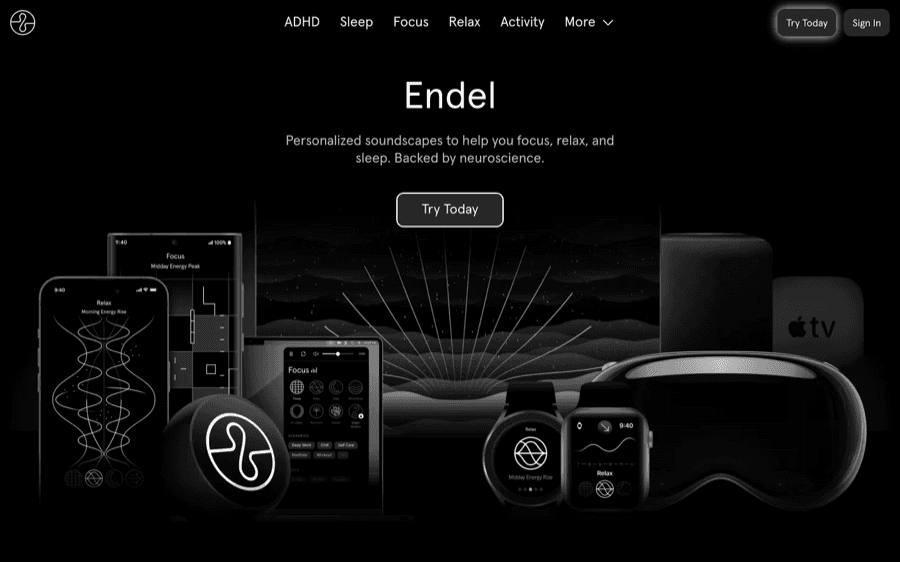
- Soundscapes in modes: Focus, Relax, Sleep, and Activity, with an ADHD mode shown in its navigation.
- NEDIO
- Instrumental focus audio (ambient, electronic, lo-fi) with no lyrics, as one stream per sprint.
What the sound responds to
- Endel
- Time of day, weather, heart rate, and location, per its site. The Apple Watch app also uses light and other biometric data.
- NEDIO
- Nothing. The stream does not adapt to you or your context.
Your control over the music
- Endel
- Choose a mode. The sound adapts on its own.
- NEDIO
- No track or style picker. You start a sprint and the stream plays.
Goals and records
- Endel
- The pages we read do not describe goal setting, a work timer, or outcome records.
- NEDIO
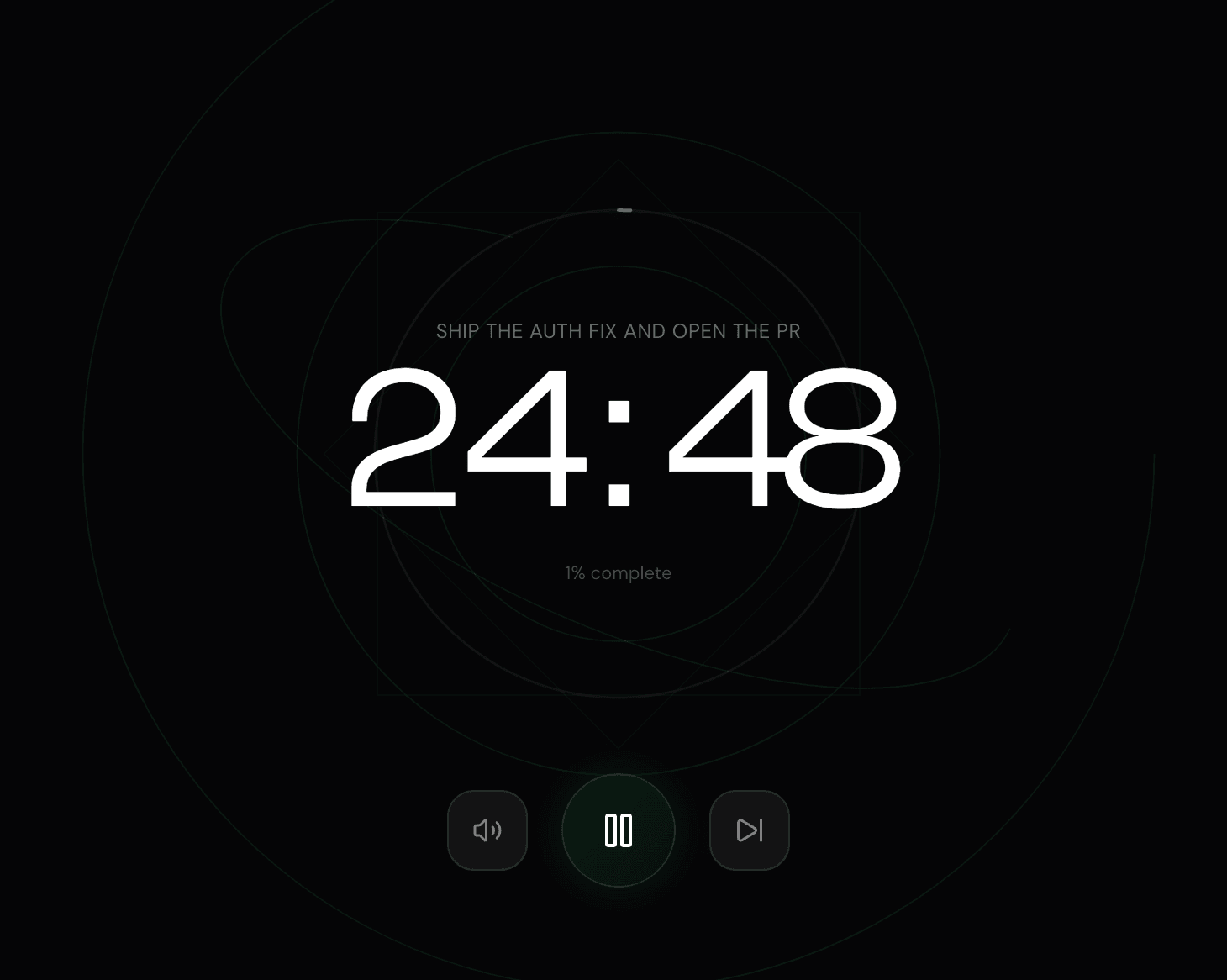
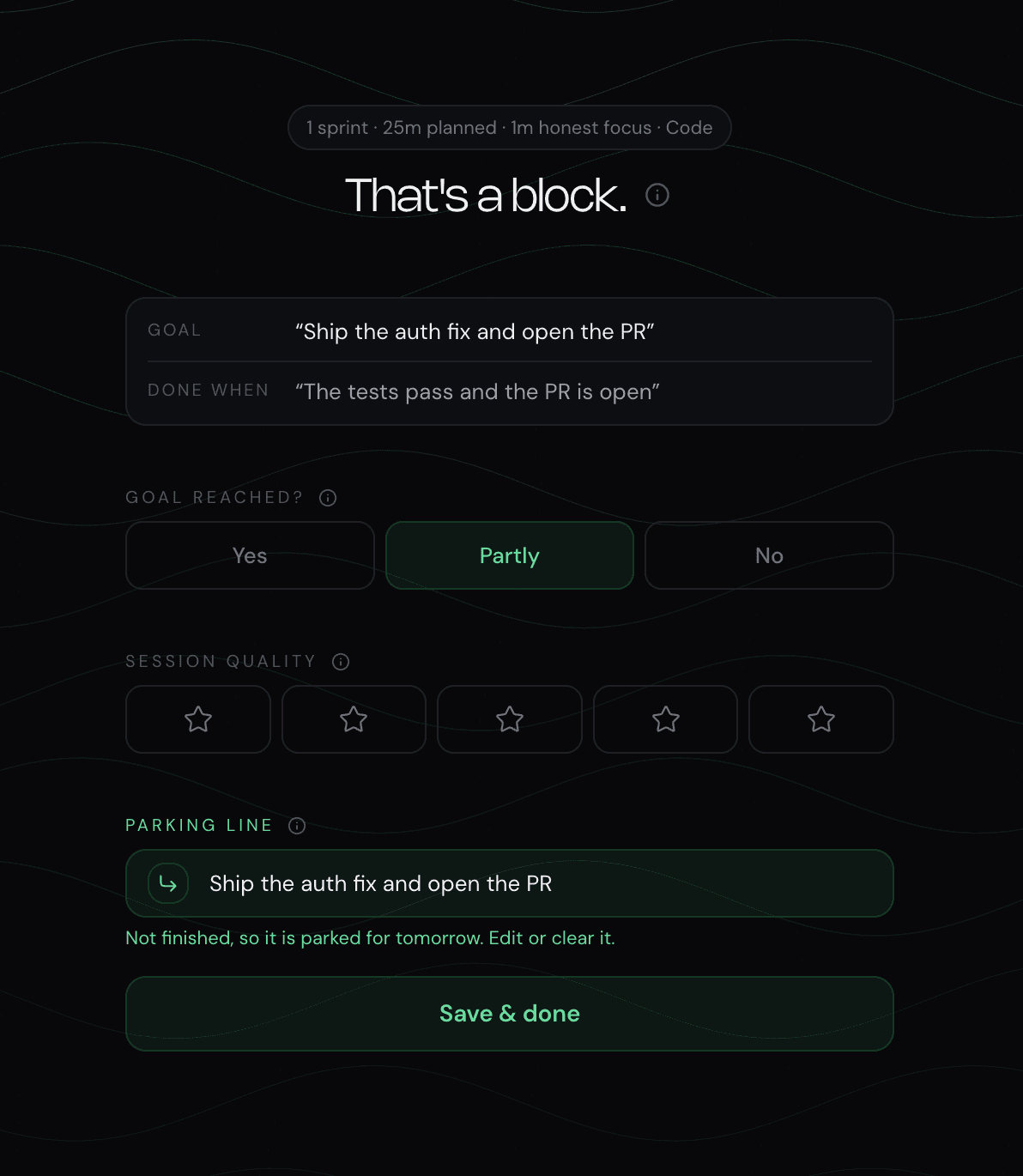
- Goal and done-when before the block. At close-out: goal reached (yes, partly, no), a 1–5 session quality rating, and a parking line for the next step. A sprint timer is the structure of the product. History and weekly statistics are on the free plan.
Platforms
- Endel
- iOS, Android, Apple Watch, Mac, Windows, web, Apple TV, Fire TV, and Alexa devices.
- NEDIO
- Browser, VS Code, and Cursor.
Sleep and relaxation
- Endel
- Relax and Sleep modes.
- NEDIO
- None. NEDIO is for working blocks.
Free access
- Endel
- A seven-day trial is listed on its App Store page, with a subscription set up. No ongoing free plan is described on the pages we read.
- NEDIO
- 30 minutes of audio a day without an account, 60 with a free account. The timer, work modes, and close-out are free, and a free account adds session history and weekly focus statistics. A sprint starts with audio, so using the allowance up also stops new sprints until it resets. Pro adds unlimited focus audio, AI Review, experiments, and experiment ledger and has a 15-day trial.
Price (checked October 9, 2026)
- Endel
- Varies by platform and tier. Its App Store page lists 12-month plans from $23.99 to $79.99 and 3-month plans from $17.99 to $41.99, plus a lifetime purchase.
- NEDIO
- Pro is $11.99 per month or $119.90 per year.
Evidence behind the audio claim
- Endel
- Cites peer-reviewed research and promotes a 2022 study of its soundscapes (details below).
- NEDIO
- Makes no neuroscience claim about its audio.
| Dimension | Endel | NEDIO |
|---|---|---|
| Where the audio comes from | Generated by Endel’s own patented AI engine, which it calls Endel Pacific, and produced continuously. | Generated with a third-party generative music tool in advance, then assembled into continuous mixes by NEDIO. |
| What you hear | Soundscapes in modes: Focus, Relax, Sleep, and Activity, with an ADHD mode shown in its navigation. | Instrumental focus audio (ambient, electronic, lo-fi) with no lyrics, as one stream per sprint. |
| What the sound responds to | Time of day, weather, heart rate, and location, per its site. The Apple Watch app also uses light and other biometric data. | Nothing. The stream does not adapt to you or your context. |
| Your control over the music | Choose a mode. The sound adapts on its own. | No track or style picker. You start a sprint and the stream plays. |
| Goals and records | The pages we read do not describe goal setting, a work timer, or outcome records. | Goal and done-when before the block. At close-out: goal reached (yes, partly, no), a 1–5 session quality rating, and a parking line for the next step. A sprint timer is the structure of the product. History and weekly statistics are on the free plan. |
| Platforms | iOS, Android, Apple Watch, Mac, Windows, web, Apple TV, Fire TV, and Alexa devices. | Browser, VS Code, and Cursor. |
| Sleep and relaxation | Relax and Sleep modes. | None. NEDIO is for working blocks. |
| Free access | A seven-day trial is listed on its App Store page, with a subscription set up. No ongoing free plan is described on the pages we read. | 30 minutes of audio a day without an account, 60 with a free account. The timer, work modes, and close-out are free, and a free account adds session history and weekly focus statistics. A sprint starts with audio, so using the allowance up also stops new sprints until it resets. Pro adds unlimited focus audio, AI Review, experiments, and experiment ledger and has a 15-day trial. |
| Price (checked October 9, 2026) | Varies by platform and tier. Its App Store page lists 12-month plans from $23.99 to $79.99 and 3-month plans from $17.99 to $41.99, plus a lifetime purchase. | Pro is $11.99 per month or $119.90 per year. |
| Evidence behind the audio claim | Cites peer-reviewed research and promotes a 2022 study of its soundscapes (details below). | Makes no neuroscience claim about its audio. |
Sources: endel.io, endel.io/science, Endel on the App Store, and NEDIO’s pricing page. Endel is a trademark of its owner.
Where the audio comes from
Both products use AI-generated audio, in different ways. Endel says all its sounds are generated by its proprietary, patented AI engine, Endel Pacific, and that the soundscapes are endless. The sound is produced continuously and, per its site, responds to time of day, weather, heart rate, and location.
NEDIO’s audio is generated in advance with a third-party generative music tool, then assembled into continuous mixes. It is not recorded by performers or licensed from a music library, and it does not adapt to you. NEDIO makes no claim of modulation or entrainment. See our terms for how the audio is licensed to you.
So the real difference is not human versus AI. It is a live adaptive engine that Endel built, against a fixed stream that NEDIO selected and arranged.
What the evidence covers. Endel promotes a 2022 study in Frontiers in Computational Neuroscience (Haruvi et al.). In 62 adults over four one-hour sessions at home, wearing an EEG headband, personalized soundscapes increased focus above silence, while popular focus playlists did not significantly. For 18–36-year-olds, all audio tested beat silence. Endel’s marketing describes the result as “7× better”; the abstract does not give that figure. It is a study of Endel-like sound with brain-computer measurement, not of developers programming, and it measures focus states, not work output. Check the paper’s disclosures for funding. NEDIO has no comparable study.
Primary sources and references
These peer-reviewed papers are linked through their DOI records or publisher pages. They support the directional claims in this article; none directly measures long, production-grade software development.
- Haruvi, A., Kopito, R., Brande-Eilat, N., Kalev, S., Kay, E., & Furman, D. (2022). "Measuring and modeling the effect of audio on human focus in everyday environments using brain-computer interface technology." Frontiers in Computational Neuroscience, 15, Article 760561.
DOI: 10.3389/fncom.2021.760561
A study of 62 adults (18–65) in four one-hour home sessions with EEG. Personalized soundscapes increased focus above silence (p = 0.008); popular focus playlists did not significantly. The study was run by Arctop, a brain-decoding technology company, using Endel’s soundscapes, and Endel promotes it, so check the paper’s disclosures for funding.
- Elbe, P., Marsh, J. E., Sörman, D., & Nyberg, L. (2025). "Differential impacts of addition and omission deviants on the working memory performance of adults with and without self-reported ADHD." Journal of Cognitive Psychology (advance online publication), 1–16.
DOI: 10.1080/20445911.2025.2563538
A laboratory study of 66 adults with self-reported ADHD and 66 without: sound dropping out of a steady background disrupted the ADHD group more, while sound being added disrupted the other group more. It suggests changes in sound are a variable worth testing in any adaptive product.
Three ways to run it
The real comparison is between setups, not logos.
Endel alone
Pick a mode, let the sound adapt, and work.
You give up: a goal, a work timer, and a record of whether you reached the goal, unless you keep them elsewhere.
Cost: varies by platform; see the table.
Endel plus your own timer and notes
Keep the timer and task list you already trust and use Endel for sound, sleep, and walks.
You give up: a single place for the whole block. Two or three surfaces to open before you start.
Cost: Endel plus whatever your timer and notes tools cost.
NEDIO
Write a goal and a done-when line, start the sprint, hear the stream, and close out.
You give up: adaptive sound, sleep and relaxation, watch and TV apps, and a polished soundscape design.
Cost: free with a daily audio limit, or Pro at $119.90 per year.
Where Endel wins
- Adaptive soundscapes. Sound that responds to time of day, weather, heart rate, and location, with many textures. NEDIO’s stream is fixed.
- Sleep and relaxation. Endel has Sleep and Relax modes, and cites research on sleep soundscapes. NEDIO has none, and does not try to.
- Devices. iOS, Android, Apple Watch, Mac, Windows, web, Apple TV, Fire TV, and Alexa. NEDIO runs in a browser, VS Code, and Cursor.
- Design and polish. Its app is carefully designed and well rated; the App Store listing shows 4.6 out of 5 across about 34,000 ratings. NEDIO is a narrower, plainer tool.
- Published research on its focus sound. A peer-reviewed 2022 study with EEG, described above. NEDIO has nothing comparable.
- Modes beyond coding. Activity and ADHD modes, for walks, exercise, and non-coding focus.
Where NEDIO fits
NEDIO fits when the bottleneck is the work itself, not the sound. You write a goal and a done-when line, the timer and audio start together, and the close-out records whether the goal was reached and what to pick up next. Over time the history and weekly statistics show how your blocks went.
It does not read your code, verify that anything passed, or tell you whether the music helped. It records what you tell it. It is also narrower than Endel on purpose: no sleep, no relaxation, no adaptation, no watch or TV apps.
My experience with both
Disclosure. I founded NEDIO. This is one person’s experience, roughly one week with each product. It is self-reported and not blinded, and I took no measurements.
Endel. I liked how much texture the soundscapes have. The music is made well. Endel says its sound is generated by its own AI engine, which matches what I suspected. The product design is very good too: everything about the app is beautifully done. But for me it is mostly the music. The experience stays at the level of sound.
NEDIO’s audio. The music is not worse. It put me into the same focus state that Endel did, and at the same high quality. On sound alone I could not say one was clearly better.
What decided it. NEDIO is a focus workspace rather than an audio product. Working in blocks, managing sprints, and the analytics of those blocks fit much more strongly into how I actually work, and they support the rhythm of my work sessions. With Endel I got a good sound. With NEDIO I got a comparable sound plus a structure around each block.
What this suggests
- When two audio products feel equally good, the surrounding workflow decides the choice.
- Endel’s design and texture are real strengths that a plainer tool does not match.
- For someone who already has a timer and task habit, Endel may be the better fit.
What it does not show
- That either audio changes focus. I could not separate the audio from the routine around it.
- That my result transfers to you. It is one person, one task mix, and a short test.
- That the weeks were comparable. Workload, novelty, and expectation all differ between weeks.
Run your own two-week test
One five-workday week per product, on the same kind of task (pull requests, or feature work), at roughly the same time of day. Change only the audio and timer layer. Log these every working day:
Date:
Product this week: Endel / NEDIO
Minutes from "I should start" to first keystroke:
Context switches in the first ten minutes:
Did the sound change in a way I noticed? yes / no
Focus, 1 to 5:
Did I reach the block's checkpoint? yes / partly / no
The sound-change line is there because adaptive audio is the main thing that sets Endel apart, and whether it helps or distracts is personal. Track it rather than assuming.
Limits to respect. The week you try second has an advantage or a disadvantage from familiarity, so swap the order with a colleague or add a third week with the first product. A new tool is more interesting than an old one for a few days. You know which product you are using, which colors your ratings. Workload differs between weeks. Self-rated focus is noisy. Two weeks tell you whether you can live with a product’s limits and whether the start routine changed. They do not show an effect on focus.
If the two weeks look the same, keep the cheaper or simpler setup and look upstream of audio: meetings, review latency, unclear tickets. For a longer log tied to audio type, see the two-week audio log.
Choose by condition
Endel fits if:
- You want adaptive soundscapes that respond to your day, and many textures.
- You also want sleep, relaxation, or movement audio from the same app.
- You need iOS, Android, a watch, a TV, or Windows apps.
- You value a polished app and published research on the focus sound.
- You already start sessions reliably with a timer and task list you trust.
NEDIO fits if:
- You want a goal, a timer, a close-out, and analytics around coding blocks, in a browser, VS Code, or Cursor.
- You care more about the rhythm of your work sessions than about the sound.
- You want an ongoing free plan before paying anything.
- One fixed AI-generated stream with no adaptation is acceptable to you.
- You do not need sleep, relaxation, or mobile and watch apps from the same product.
Frequently asked questions
Is Endel better than NEDIO?
Neither is better for everyone. Endel is stronger on adaptive soundscapes, sleep and relaxation modes, devices (including watches and TVs), design, and published research on its focus sound. NEDIO is stronger if you want goals, a sprint timer, and a close-out around coding blocks in one tab. The condition list on this page maps which fits which situation.
Is the music in both products AI-generated?
Yes, but differently. Endel says all its sounds are generated by its proprietary, patented AI engine and produced continuously, adapting to context. NEDIO’s audio was generated in advance with a third-party generative music tool and assembled into continuous mixes by NEDIO. NEDIO’s stream does not adapt to you.
Does Endel have a timer or goal tracking?
The pages we read do not describe a work timer, goal setting, or outcome records for Endel. NEDIO is built around them. If Endel includes timing features we did not find, check the app. Many people pair Endel with a separate timer and task list.
Can I use Endel with my own timer instead of NEDIO?
Yes. Endel plus the timer and task list you already trust is a coherent setup, and it keeps adaptive sound and sleep modes. The comparison is whether one tab for goal, timer, audio and close-out removes friction for you. If your current start routine works, you may not need to change anything.
Which is cheaper?
As of October 9, 2026, Endel’s price varies by platform and tier; its App Store page lists 12-month plans from $23.99 to $79.99 and a lifetime purchase. NEDIO has a free plan with a daily audio limit, and Pro is $11.99 per month or $119.90 per year. Prices change, so check each vendor before you pay.
How long should I test them?
Two weeks: one five-workday week per product, on the same kind of task. To reduce order effects, have half of a team start with the other product, or add a third week with the first product again. A week is enough to learn whether you can live with a product’s limits. It is not enough to show an effect on focus.
Does adaptive sound hurt debugging?
For some people it may. We found no study of adaptive soundscapes during programming. A laboratory study of adults with self-reported ADHD found that sound dropping out of a steady background disrupted them more than sound being added, so changes in sound are worth tracking in your own log.
Does either product improve productivity?
We found no study that tests either product on developers’ work output, and this page does not measure it. Endel promotes a 2022 laboratory study of its soundscapes with EEG. NEDIO makes no such claim. The author’s own comparison, described above, is one person’s experience and not evidence of an effect.